


Description
Divorce is a legal process. Untangling your money is a separate one.
The decree says who gets what. It does not tell your creditors anything. A
joint credit card stays joint until it is closed or refinanced — and if
your ex-partner stops paying it, the lender comes to you, decree or no
decree. The divorce financial reset works through the accounts, debts and budget the decree leaves untouched.
This workbook walks you through the financial separation in four phases, in
the order that actually protects you.
The four phases
- Stabilize — secure income, housing and access to
money before anything else moves. - See everything — a complete inventory of assets,
debts and accounts, including the ones that are easy to forget. - Separate — close, refinance or divide each account,
in a sequence that does not leave you exposed. - Rebuild — credit, retirement and a budget built for
one income instead of two.
What’s inside
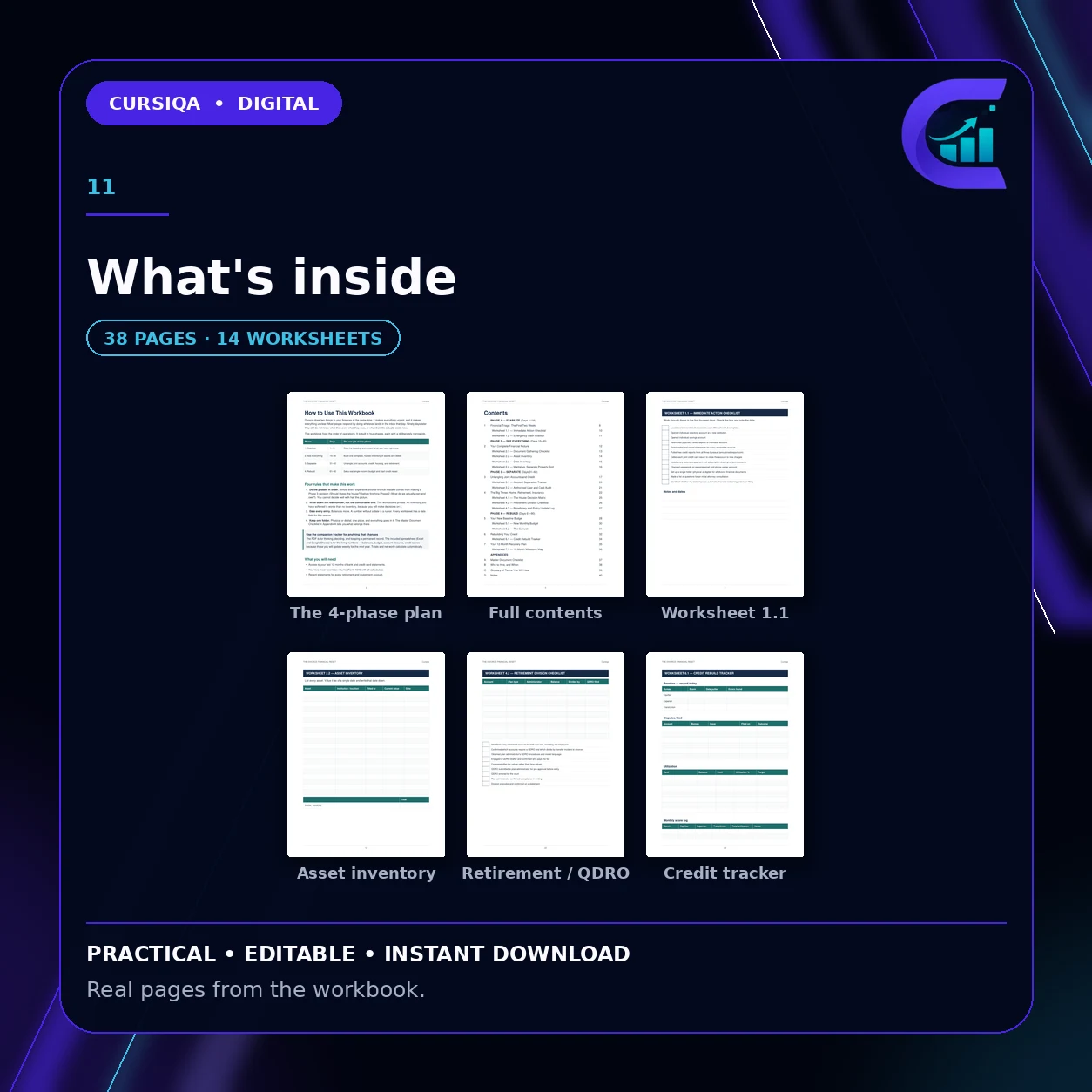
- 38-page workbook with 14 guided worksheets and 4
appendices - 10-tab tracker for Excel and Google Sheets, with net worth
and runway calculated automatically - Joint-debt exposure flagged clearly — every account a creditor can
still pursue you for - Retirement division explained, including what a QDRO is and why dividing a
401(k) without one can be expensive - Credit utilisation and housing-cost warnings built into the tracker
Written to be honest about the hard parts
It explains why being an authorized user is different from being a joint
account holder, why closing every shared card at once can hurt your credit
score at the worst possible moment, and what to compare when you are deciding
whether to keep the house.
This is an educational and organizational tool, not legal, financial or
tax advice. Divorce law varies by state and your situation may include facts
this workbook cannot know. Use it to get organised and to ask your attorney and
tax professional better questions.
What the divorce financial reset includes
The divorce financial reset is a PDF workbook with an editable tracker. It covers separating joint accounts, inventorying assets and debts, calculating your real net worth, and rebuilding a budget that works on one income rather than two.